I've lived in Tampa now for almost four years, and I've found acceptance here. It took plenty of salt water to wash all the layers of big northern cities from my skin, but I feel like I fit in now. Some of that has to do as much with the place as with me - Florida has been host to transplants for centuries - the Spanish, the English, Americans and more recently "northerners." In my travels though, I've found that some southern cities and towns are less accepting of this, and though they invite you in with a warm smile and a beer-battered meal, they subtly and politely remind you that their south and yours are not the same thing.
Deeper South
You can gawk and point fingers
At the monuments to those
Of cursed memory.
Snap pictures on the sly
Of the bones of the saints
And the Fiji Mermaids
That we keep shackled
In the vaults of our cathedrals.
Fumble your blunt tongue
Over the broken sidewalks
Of our quaint street names and sayings.
But it isn’t your blood That once cut rivers through the
Fields coarse hands work.
Those names carved in the stones
Set atop that hill, they
Aren’t any relations of yours.
To you it’s a second language; Rebranding our memories With your Instagram photos.
You’re fashioned from data analytics,
Not shale or corn cob, or red clay
Bound in plastic, not kudzu, and
The deep delta mud under your fingernails
Wasn’t born there.
As a child, you never learned the rhymes
That teach you which path will grant you
Safe passage past the witch’s cave.
So occupy the outer rings of our circles
Sample our music and shine
Purchase a plot of land,
But know you well, Not one or all
Of those things
Will ever make you
In my travels throughout Florida and the southeastern US as a whole, visiting various lesser known monuments and historical sites has revealed to me a stark and disheartening difference in the way some of them have been preserved. While removing or relocating confederate civil war monuments and statues has triggered outrage among some (especially and not surprisingly white supremacy groups), important historical reminders of black history such as cemeteries and, in at least one case, an entire town that was destroyed by racial violence, have been plowed over and erased from the map for decades with hardly any notice. In the wake of George Floyd's murder and the ongoing protests around the country over systemic racism and police brutality, it seemed like the right time to shine a spotlight on some of these little known spots. There are a great many other sites, including those along the Florida Black Heritage Trail, but this just reflects some of those with which I am most familiar.
1. The Harlem of the South
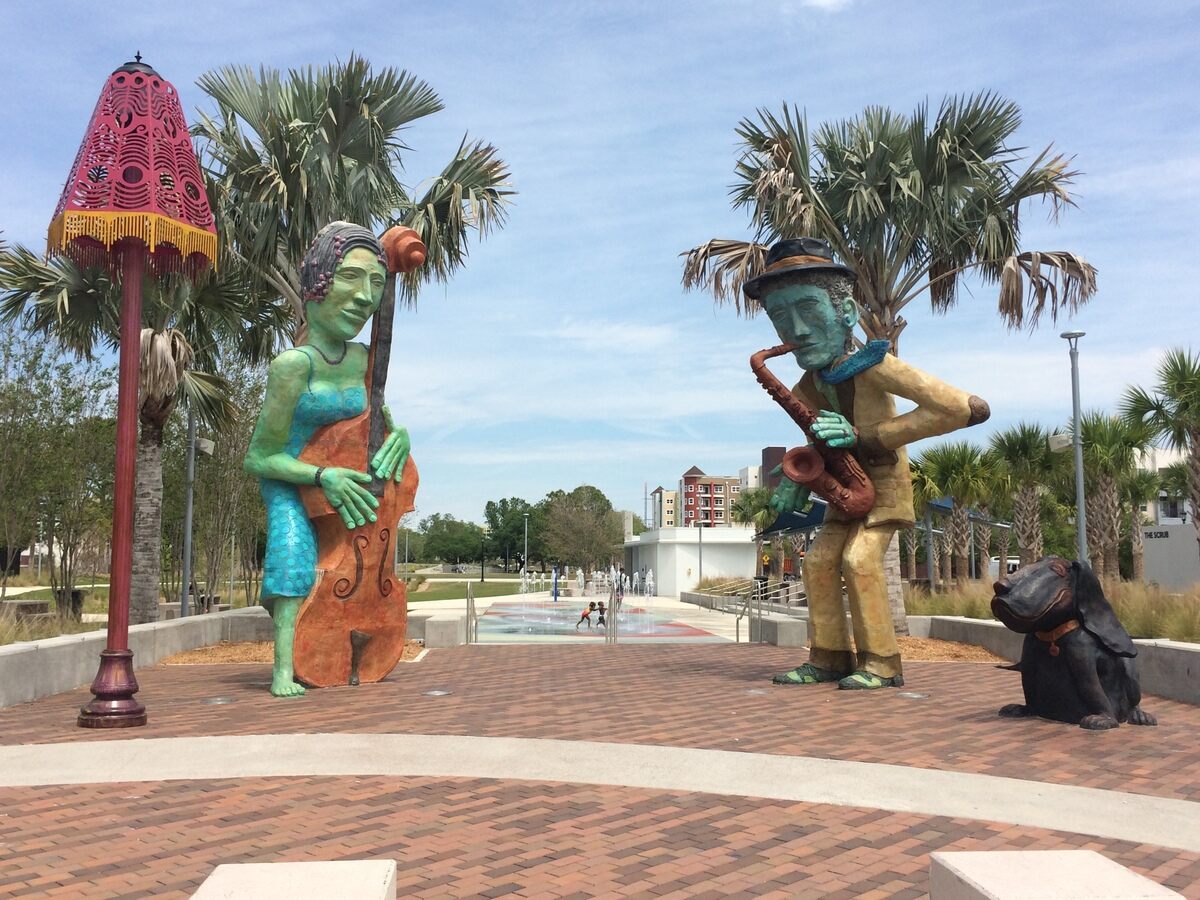
During segregation, roughly half of all black people living in Tampa occupied the area known as the Scrub. Central Avenue there became the black business and entertainment district, known as the Harlem of the South, with almost 100 shops and storefronts. Those businesses included a boarding house where "The St. Pete Blues" was recorded by a little known musician at the time named Ray Charles. That song would go on to be his first major hit. Today Central Ave is the site of Perry Harvey, Sr. Park and displays along the sidewalk illustrate the development, culture, history and key figures that made Central Avenue a success up until it's decline the sixties. The shooting of a 19-year-old black man named Martin Chambers by a white police officer in 1967 led to rioting and essentially closed the chapter on Central Avenue's many decades of prosperity.
2. Progress, One Step at a Time
In other posts I've mentioned my deep affection for St. Augustine, with it's centuries of history dating back to Spanish and English occupation. On a more recent trip there, I discovered that it also contains an important piece of much more recent, Civil Rights history, in the form of several bronze footprints near the corner of King Street and St. George Street. Known as Andrew Young's Crossing, the footprints terminate abruptly at the spot where the young activist was knocked unconscious by an angry white mob while leading a peaceful protest march on behalf of Dr. Martin Luther King. Young and his marchers remained true to the ideal of passive resistance and endured the brutal beatings. This has been cited as one of the events which led President Lyndon Johnson to pass the Civil Rights Bill on July 2nd, 1964. Young went on to become America's first African American U.N. Ambassador and subsequently Mayor of Atlanta. He has since returned to St. Augustine multiple times, completing the path from which he was once forcefully prevented.
3. Where is Rosewood?
If you've ever visited the quaint beach community of Cedar Key, you likely drove past a historical marker along Florida State Road 24. That marker is essentially all that remains of the town of Rosewood, which was torn apart and set ablaze when racial tensions erupted into a violent massacre. Rosewood was once a peaceful lumber town, but that all changed on January 1st, 1923 when a white woman accused a black man there of assaulting her. According to the marker, "In the search for her alleged attacker, whites terrorized and killed Rosewood residents. In the days of fear and violence that followed, many Rosewood citizens sought refuge in the nearby woods. White merchant John M. Wright and other courageous whites sheltered some of the fleeing men, women and children. Whites burned Rosewood and looted livestock and property; two were killed while attacking a home. Five blacks also lost their lives: Sam Carter, who was tortured for information and shot to death." The death toll is actually now believed to have much higher and that the female accuser was trying to cover up an affair. Though profoundly tragic and disturbing, many have not heard of the events that transpired in Rosewood, because for almost 60 years the massacre was a taboo subject, until former residents began reluctantly opening up about it in 1982.
4. Green Benches, Invisible Bars
As far back as 1916, the city of St. Petersburg knew it was going to become a major tourist destination. Toward this end, Mayor Al Lang realized that amid the beaches, shopping and other attractions, visitors would appreciate a comfortable place to sit. So he began regulating the dimensions, size and color (green) of the benches around the city. Thousands of them sprung up - you can still see the smiling faces of people sitting on them in old postcards. Smiling, old, white faces, that is. According to Ray Arsenault – John Hope Franklin Professor of Southern History at the University of South Florida St. Petersburg, "the black residents of St. Petersburg had their place, but that place was not on the green benches." They weren't expressly forbidden from them, but they didn't have to be - it was simply understood. Eventually, in the 1960's, the City realized the error they had made and removed the benches in an attempt to rebrand the city as younger as more diverse. But the damage was done and the connections between the green benches and systemic racism was inseparable. Today you can still find one of those few remaining green benches in the Florida Holocaust Museum.
5. Separate and Unequal... in Death as in Life
I dedicated a chapter to this subject in my upcoming book, "Secret Tampa Bay: A Guide to the Weird, Wonderful and Obscure," and the story is unfolding in real time as more cemeteries are discovered, so I won't say too much about it. Suffice it to say that as many as a dozen of the Tampa Bay area's oldest black cemeteries very quietly slipped off the map and became lost. The oldest of these, Zion Cemetery, was recently discovered to have been underneath public housing for the last 70 years. In their haste to cash in on available land, the developers never even bothered to move the coffins. To compound the pain of those family members who are learning that the graves of their relatives were ignored and built over, many of the residents there have had to be relocated. More recently another black cemetery was discovered under a local high school and now it appears that a third may have been found in Clearwater. Still others will likely be rediscovered in the coming days - a painful reminder of how black history and bodies have been bulldozed, erased and forgotten.
As mentioned previously - these are just a very few of the vast number of historically and culturally significant black history sites in central Florida. There's the home of Zora Neale Hurston, Fort Mose, the Bing Rooming House Museum, school houses, churches, cemeteries and monuments. I plan to explore this topic further, and I look forward, as always, to sharing with you what I discover.
I flip the turn signal and make the next left. The beams of the headlights of my Ford Taurus slice through the jet black darkness as the road bends and curves under a canopy of trees.
After we pass a half dozen intersections, Steve jumps in with a "right."
I flip on the turn signal again and we wind deeper into the unknown, my friends alternating in giving instructions.
We didn't do it that often and the three of us didn't spend a lot of time together. I was the shared friend between the two of them - Jason, with whom I went to the same high school and Steve with whom I had grown up. I seem to recall that the three of us had just finished a new issue of Dharmacation, which was the successor to Driftwood, the magazine that Steve and Geoff and I had had started together - a local zine/literary magazine (possibly one of the very first to include online submissions). Geoff had moved on to other projects and Steve and I had continued our endeavors under a new name, and brought Jason in. It didn't have the same dynamic, but it worked well enough, for a while.
Our goal that particular evening was just to get as far from what we knew as we could, while still being "responsible" enough to get back home at a reasonable time. I was living with my dad at that point and he may or may not have been traveling in some other state or country, so "a reasonable time" was pretty loosely defined. Generally I interpreted it to mean at least a couple hours before sunrise.
The few times we tried this activity/experiment or whatever you want to call it, we seemed to always end up in Morrisville out around New Hope and the New Jersey border. The challenge was to get to some place we had never been before, and then see if we could retrace our route back to those roads and streets that we knew like the back of our hands.
It was a weird bonding activity, but hey, we were weird kids. While some kids drank or smoked or played with drugs, our form of rebellion manifested itself in trying to get lost - something that each of us had been advised to do on a fairly frequent basis. And as we attempted to get lost and then unlost, we listened to punk rock and alternative music, or we just turned the radio on and listed to the Princeton college radio station. I think REM's album, Automatic for the People came out around that time - maybe that's what we were listening to.
There was a sense of satisfaction when we finally realized that we had achieved our goal and nothing looked familiar anymore. And there was an equal sense of accomplishment in getting back to our small known world. Manufactured stress and artificial relief - but to us it was real enough.
And now, nearly 30 years later, Steve is gone, Jason is somewhere, and I find that I'm doing something similar to what the three of us did together as teenagers. I go for long drives, hours some times, looking for something I haven't seen before. It's different now in that I always know where I'm going - I have a specific destination in mind. And you can't really get lost anymore - not with seemingly every point on earth now mapped out in a smartphone application. I don't have to stop and ask for directions, unless what I'm looking for is really hard to find - a miniature roadside monument, an abandoned cabin deep in a swamp, an enigmatic gravestone or something to that effect. It's never because I don't know where I am.
Having to pull into a gas station and have someone behind the counter pull out a map and puzzle over how the hell we ended up wherever the hell we did - that's probably not an experience that teenagers today or at any time in the future will be able to relate to. We've lost our ability to be lost, and with it, I think, something important, a kind of wonder. Or rather, the potential for wonder. We don't puzzle over what's around the next bend in the street - we can see it all on google maps. Where to stop for a snack, where to fill up with gas, where to take the best picture - it's all right there at our fingertips. But once known, once the route is planned and plotted and mapped, it cannot ever again be unknown. There are some things that can only be found when you're not looking for anything. And for all the big, ten dollar words I've so carefully accumulated and collected over the years, I have trouble articulating quite how that makes me feel - trying to hold onto a shared memory when those you shared it with and when even the very world in which you shared it have all vanished. Wonderloss, I guess; a very specific type of nostalgia heartache, and it's heavy on me tonight as I write this.
I feel rather than hear that familiar, silent voice whispering, "go on, get out of here. Get lost...
Since I recently shared my St. Augustine Adventure List, I thought I would delve a bit deeper into one of the locations mentioned in that post (The piece below was previously published on Atlas Obscura. You can see it here).
St. Augustine's record-setting narrow street was designed to protect against pirates.
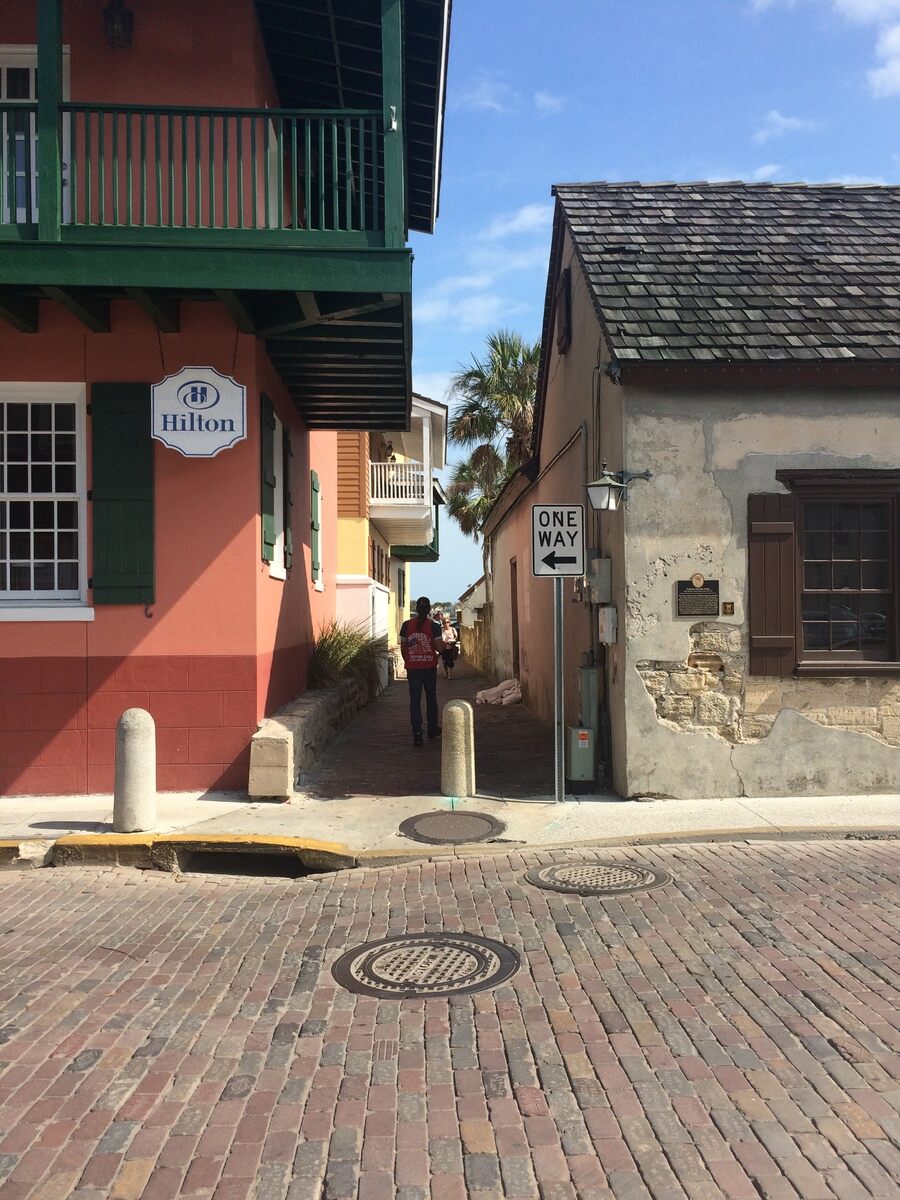
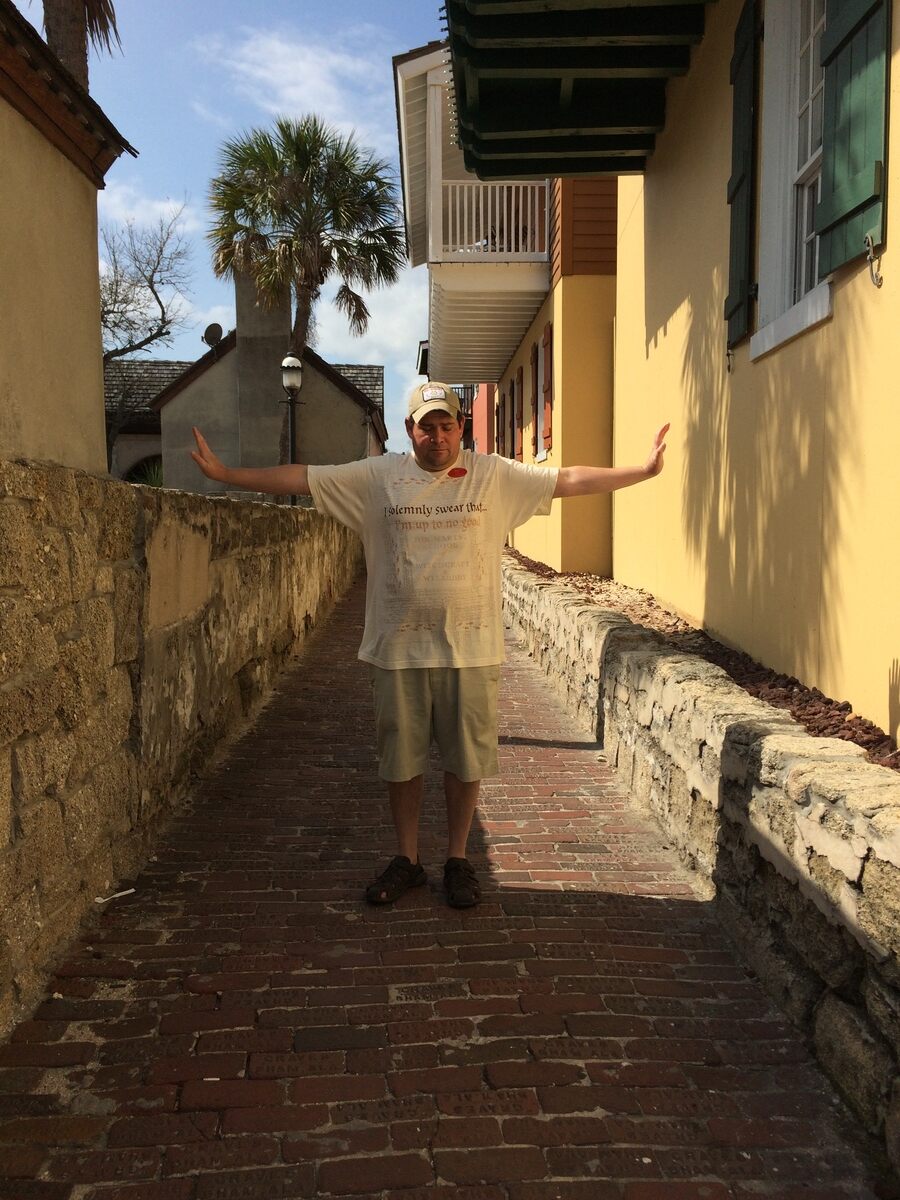
Measuring just seven feet wide, St. Augustine's Treasury Street may be the narrowest street in the United States. And the lane is skinny by design. Treasury Street connects Bay Street on the waterfront with what used to be the Royal Spanish Treasury. Local legend says the street was built just wide enough for two men to carry a chest of gold to and from ships docked on the bay, but not wide enough for a horse-drawn carriage to squeeze through and ride off with the money. In the former Spanish port, piracy was a serious concern, especially in the walk between the bank and the bay.
When I started writing Secret Tampa Bay, I wasn't sure how I could possibly fill 206 pages. After several months of work though, I ended up not with too little content, but rather with far more than I could possibly include. Deciding what to omit was difficult as I'm proud of the research and writing I did on each chapter - consequently I'll be sharing here some of that extra content here with you.
This particular piece I decided not to include for two reasons: 1) with so many things that readers might want to explore in the Tampa Bay Area, I didn't think it was the right choice to include something that they would probably rather not experience, and 2) the phenomenon known as "lovebug season" isn't really specific to Tampa Bay - the nasty little things can be found in multiple states throughout the southeast and along the Gulf coast. They are presently out in force, so it seemed like the ideal time to share this with you.
Insectile Orgy
of Death
What are all
those nasty-looking little things stuck to everyone’s front fenders and
windshields?
The subject of this chapter highlights not something you’ll likely want
to rush out to experience for yourself, but rather something you might prefer
to avoid, if you can. And it revolves around the two words that makes
motorists, visitors and even long-time residents consider an indoors activity:
lovebug season.
The first documented reference to lovebugs (Plecia Nearctica) along the
Gulf Coast can be traced to Louisiana in the early 1900’s. At the time their
known habitat included Florida, Texas, Alabama, Louisiana and Mississippi.
Since then they have spread to Georgia, South Carolina and elsewhere.
Most years see two lovebug seasons, each lasting a few weeks. Typically
the first season occurs sometime in April and the second around late August.
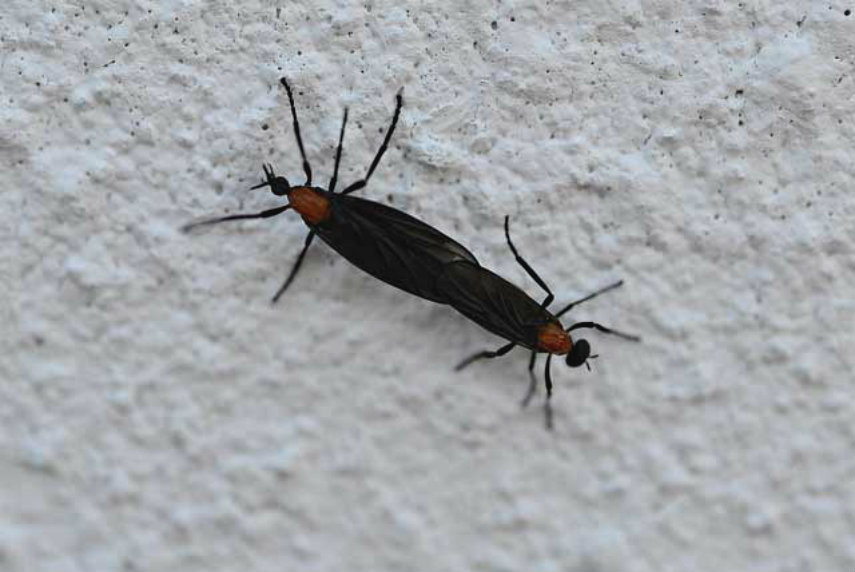
During these periods, millions of these sex-crazed insects will mate and
remain conjoined, even after one of the pair has died, and take to the sky.
Clouds of lovebugs will then hover lazily over any light colored or
light-reflective surface (including highways and cars).
They don’t pose any threat to humans as far as bites or stings –
although they do cause plenty of individuals to swat at the air and themselves
as if suffering from a fit of the world’s worst dance moves. They are also a
nuisance to drivers against whose windshields they tend to splatter, and due to
the acidity of their body chemist, if not removed fairly quickly from
automobiles, their remains become exceedingly difficult to wipe away.
Despite evidence of natural migration, there remains a persistent myth
that lovebugs were genetically modified and introduced to the area (either
accidentally or intentionally) by the University of Florida or some other
research organization in a failed attempt to curb mosquito populations.
Know your amorous insects: Lovebugs are annoying but harmless. Kissing
bugs, on the other hand, are nocturnal, bloodsucking parasites that carry an
inflammatory infectious disease which can be deadly.
Public
Display of Annihilation
What: Lovebugs
Where: Everywhere you least want them to be.
Cost: None, unless you factor in the cost of a good carwash
Pro Tip: Bug repellant won’t keep away lovebugs, but it will help with
mosquitos and biting flies. Always keep some handy.
This blog has been an interesting experiment for me thus far, and I hope you are finding as much pleasure in reading it as I am in creating it. It's more planned than journal writing - I keep a running list of potential subjects - but far less structured than typical story telling. This stands to reason, since the end of this particular story is unknown to me - I'm directing and documenting it as it occurs. Consequently, there is from time to time a plot twist, which catches me by surprise every bit as much if not more than it likely does you.
Specifically, I'm thinking about my forthcoming book "Secret Tampa Bay: A Guide to the Weird, Wonderful and Obscure," which is tentatively scheduled for release in the early fall of 2020. Five years ago, writing an offbeat travel guide is just about the last thing I would have expected to do, but it seems that digging deep into my surroundings and my own past has inadvertent revealed a path forward.
Without realizing it, I had been lining up the pieces and doing the work long before the shape of it became clear. It happened about a year ago while I was flipping through the pages of "Secret Philadelphia: A Guide to the Weird, Wonderful and Obscure." I had purchased the book for a trip to see my family in suburban Philly, but the short vacation never actually happened. While Jen and I were waiting to board the plane, which had been delayed, we got a call from her mother informing us that her dad had been taken to the hospital. So after a short discussion, we left the airport and went straight to Sarasota. It was unquestionably the right thing to do and I am glad we could be there for her parents, but I was understandably a little crestfallen about having to postpone a trip I had been looking forward to. So I immersed myself in the hidden history and little known locations in and around the place I grew up.
At the same time I was just beginning to notice some things changing in my professional life. For seven years I'd enjoyed a very steady flow of work as both a resume writer for Your Signature Resume and as a contractor with the proposal writing team at Grant Thornton. It could have just been the usual fluctuations that all of us in the "gig economy" become accustomed to over time, but something about it felt different. Rather than wait and find out, I decided to start actively seeking out an additional stream of revenue.
That's when it occurred to me - I could write Secret Tampa Bay, maybe. The website Atlas Obscura had already published many of my submissions and I was already well into writing this blog. So I went online and looked through the catalog of Reedy Press books to see if they already had a volume on Tampa Bay. They did not. Next I made a mock table of contents based on locations and local objects of intrigue that I could write about (only about half of which actually made it into the book). I called to inquire about it and was directed to the owner. I left a message and he promptly called me back and asked if I could share some writing samples. I complied and again he responded swiftly asking for a marketing plan. I constructed one based on the guidelines he had given me, and within just a week or two I was looking at a contract.
Once everything was signed, I redoubled my efforts to seek out and discover all that is peculiar and fascinating in the area. I set for myself a radius of 1 hour from downtown Tampa, which allowed me to cover not only Tampa, St. Pete and Clearwater, but as far north as Weeki Wachee, and as far south as Sarasota. Initially I wondered how I could possibly fill more than 200 pages, but as I near the final, published product, I find that I have almost twice that much material and that the greatest challenge has been not what to include but rather what to exclude. Some of that excess material will no doubt appear here in future blog posts.
I'm excited. I'm exhausted. But mostly I am profoundly grateful; to Reedy Press for providing me with the opportunity; to my wife and family for their support of my project; to all of those who let me in on their local knowledge and secret worlds, and especially to my old friend Steve. Had his passing not shaken me awake and altered my trajectory, nothing over the past few years in my life would have turned out as it has. I wish he could have been the first one to look at my initial draft - a role we always played for one another, the friend able to offer a frank but thoughtful critique. This time it has been not his presence but his absence that helped shape the work. His shadow falls across the book as it does this blog, and on any of the occasions where I've uncovered or stumbled across something that made me drop my jaw in awe, he's with me then. I believe he would be proud of what I've done.
As kids we adopted as our own a line from the film The Adventures of Buckaroo Banzai Across the 8th Dimension, "No matter where you go, there your are." I have since amended the saying slightly to reflect his current, posthumous role in my ongoing adventures: "No matter where I go, there we are."
And now, reader, you too are there with us. I appreciate that, and I thank you for joining me in all that has passed and in all that is yet to come.
Of all the places Jen and I have traveled within the state of Florida, St. Augustine is hands down our favorite. As the oldest continually occupied city in the country, there is no other place in the Sunshine State, or all of America, for that matter, that makes me feel more like I'm wandering through the vestiges of the Spanish empire. From the 17th century fortress built from coquina to withstand cannonballs to the pirate museum, the myriad ghost tours, the Ponce de Leon Archaeological Site and a slew of fantastic restaurants, every time we visit we discover something new, or old, rather. Here is the adventure list we composed for our first visit three years ago. It is by no means comprehensive, but it was enough to keep us busy for a few days.
Item #1: Casablanca Inn - Our mini adventure began at the Casablanca Inn, which was a charming B&B that appealed to both Jen and I for different reasons. Casablanca is one of Jen's favorite films; I was more interested in the fact that some consider the 1914 building to be one of the more haunted spots in one of America's most reputedly haunted cities.
Item #2: Pirate & Treasure Museum - With artifacts and treasures recovered from various pirate ships on display and histories of some the area's most infamous buccaneers, this was a must see for me and it did not disappoint.
Item #3: Potter's Wax Museum - The first established wax museum in America, set inside the country's oldest pharmacy.
Item #4: Villa Zorayda - An Alhambra-inspired building that houses a fantastic collection including possibly the oldest rug on earth said to be woven from Egyptian Nile cat hair (The Sacred Cat Rug, as it is called, is the subject of another blog entry).
Item #5: Ponce de Leon Hotel (Flagler College) - Once an opulent hotel, now home to Flagler College and the subject of a blog post elsewhere.
Item #6: Ghost Tour - St. Augustine is said by some to be the most haunted city in America. For our first visit we went on the Ghosts and Gravestone Tours which is probably the largest such tour operator in town.
Item #7: Treasury Street - The narrowest street in the United States by design as a defense against pirates.
Item #8: The Great Cross - Standing 208 feet high, this cross is said to mark the approximate spot where Christianity found a permanent foothold in the new world in 1565. It is part of the Shrine of Our Lade of La Leche and when it was first erected in 1966, it was the tallest cross in the world.
Item #9: Ripley's Believe it or Not! Museum - Robert Ripley surely ranks among the patron saints of offbeat travel. As a model and inspiration for me, how could I not spend time among the more than 800 odd and unusual items on display there?
Item #10: The Fountain of Youth - First explored by Juan Ponce de Leon in 1513, the archaeological site includes the remains of native people and a fountain you can drink from. It may not grant you eternal youth but it will certainly leave the taste of sulfur in your mouth for what will seem like forever.
Castillo de San Marcos
Item #11: Gator Bob's - if you're looking for the obligatory St. Augustine souvenir, this is where you will find it.
Item #12: Wolf's Museum of Mystery - This quintessentially St. Augustine experience was part curio shop, part demented house of horrors. Sadly it burned down in 2019 but the proprietor has relocated his wares to Friendship, NY.
Item #13: The Lightner Museum - This meta collection housed in the former Alcazar Hotel includes a mummy, Sir Winston Churchill's Lion ROTA (stuffed), and an awe-inspiring collection of 19th century fine and decorative art.
Item #14: Old Town Trolly Tour - Hop on, hop off and get some quick historical facts along the way.
Item #15: Love Trees - St. Augustine's love trees are composed of two different types of trees that have grown into and through one another in an eternal, symbiotic embrace. Local lore says that a kiss under such a tree will produce an equally unbreakable bond between lovers.
Item #16: The Oldest Wooden School House - Complete with a Harry Potter-esque dungeon under the stairs.
Item #17: Andrew Young Crossing Site - where a famous civil rights leader was knocked unconscious during a protest. You can follow his footsteps up the point where his forward motion was arrested for a time. He has been back several times since to complete his intended path.
Item #18: City Gates - the original entrance way to the city remains partially intact and is the site of many supernatural tales including a frequently encountered "woman in white."
Item #19: The Old Jail - Of all the supposedly haunted sites in town, this certainly was the creepiest. It was included as one of the stops along our ghost tour.
Item #20: Old Spanish Trail Zero Milestone Marker - A small monument at the Atlantic end of the Old Spanish Trail (US 80), the other end of which terminates in San Diego, California.
The Lizzy Borden room inside of the Wolf's Museum of Mystery.
Item #21: St. George Street - My agreement with Jen is that any trip involving pirates, ghosts and oddities must also include shopping. Seems pretty fair to me.
Item #22: St. Augustine History Museum - located next to the Old Jail, it provided a nice overview of the history of the region including a deeper dive into the life and origins of the Florida Crackers.
Item #23: Castillo de San Marcos - When most people think of St. Augustine, this fort is most likely what they envision. It represents the oldest masonry and only 17th century fort still standing in North America, unique not only for its design but also for the material (coquina) which was used in its construction.
Item #24: The Oldest Store Museum - Here you'll find interactive displays and a look at the "good old days" when you could purchase your meat, farm equipment, general supplies and snake oil all at the same place.
Item #25: Huguenot Cemetery - Every ghost tour Jen and I have been on stops here, as there are many tales including those of the Yellow Fever which decimated the city and the story of Judge John Stickney who is said to appear from time to time seeking his stolen gold teeth.
Item #26: St. Photios Greek Orthodox National Shrine - A lesser known spot in the city, which provides a history of the early Greek settlers in the area and a reliquary containing bones from 18 different saints, making it one of if not the largest such collection outside of the Vatican.
Item #27: Fort Matanza - A smaller lookout fort south of the city which was crucial in the defense against pirates.
Item #28: Scarlet O'Hara's Bar & Restaurant - The way I feel about Star Wars, Jen feels about Gone with the Wind. And, like virtually every other building in St. Augustine, it's rumored to have a ghost or two. The only spirits we encountered there were those we imbibed, and frankly that's just fine by us.
Item #29: Flagler Memorial Presbyterian Church - Built by the train and hotel magnate that made St. Augustine a tourist destination, in honor and memory of his daughter.
The main entrance to what was once the Ponce de Leon Hotel (now Flagler College).