Friday, May 3, 2019

Exploring the Future: Journey to the Shrine of the Mouse God


Journey to the Shrine of the Mouse God

“Well,” Glen said gleefully after scanning the oxygen levels in Jeth’s blood, “looks like it’s time for another trip down.”

Jeth zipped up his dive suite, activated the automatic compression and suction functions and then plunged into the water behind Glen, who had as little need for a suit as he did for a cooling off period between dives. While not by nature given to contemplating other possible futures, as Jeth watched Glen’s webbed hands and feet propel him effortlessly through the water, Jeth couldn’t help wonder what it might have been like to have chosen a career as a diver and been fitted with the same top of the line genetic mods as Glen – gills, salinity monitors and filtration, temperature regulation, and most noticeably, the detachable dorsal fin connected to his T7 vertebrae. But Jeth had chosen for his primary the path of an objective reporter, so all his mods (also top of the line) were related to storing, editing and transmitting data. Considerably less sexy, he frowned. As they sank into the lightless depths Jeth pondered the possibility that his fascination was bordering into something else – envy perhaps?

As they made their way lower the beams of artificial light revealed various ruined structures, the curves and loops of corroded and barnacle encrusted steel. The skeletons of civilization, from the first global era.

“As you can see,” Glen projected through his Psy Comm, “This was clearly a structure of some importance and prominence.” He gestured towards the ruined spires of a castle, which seemed impractical for either defense or occupation.

They swam in silence for a bit until they came upon a massive dome that looked like the cracked egg of some sea creature.

“What, exactly, was this place?” Jeth projected back.

“First era religious site, near as anyone can tell. Families from all countries would take their children here on a pilgrimage to the palace of the mouse god.”

“But I thought most first era religions, certainly all of those practiced in the former Union, were monotheistic?”

“Ahh,” Greg responded, “precisely why this site is so… fascinating. While they were primarily monotheistic, it appears that there were dozens of minor pantheons. You’ve got the epic heroic literature, of course, the bat, the spider, the iron suit, and so forth. But here you have a massive complex – multiple complexes, actually, devoted to an entirely different set of animistic deities.”

Jeth gathered as much information as he could – from the temperature of the water to the depths to the chemical composition and map of the structures. He tried briefly to imagine what it would have been like when it was dry and traffic consisted of petromobiles rather than schools of fish.

Jeth took his time, knowing that the window was quickly closing. Once the storms set in, it would be at least another nine months, if he was lucky, before he’d be able to explore the area again. Once he’d had his fill, he projected to Glenn. “Let’s head up, I want to parse this.”

Wednesday, May 1, 2019

Don's Existential Dilemma


“… so the only real question, the most critical question…,” Don leaned in close, almost conspiratorially, for emphasis, “is do you choose to taste the Strawberries?”

I should back up from the table at Cava Java in Ann Arbor some twenty some years ago, where I was meeting for an independent study project on existential literature with my mentor and friend Don. He was the last in a long chain of sympathetic and philosophically aligned instructors and professors, each one directing me to the next like stops along some sort of underground railroad towards a degree.

The question he posed about the strawberries though, that was the key for him. I could tell by the way his dark eyes gleamed. It cast light on Don himself, who was maybe in his mid 30's at the time - younger than I am today. As an avowed hedonist, Don's answer to the dilemma he presented was fairly simple to discern. That theoretical dilemma went something like this:

Imagine for a moment that you’re camping somewhere remote. Suddenly, a tiger comes out of nowhere, sees you and starts to charge. It’s herding you up a steep incline and at the very top, there’s a sheer drop. You climb over the ledge and hold onto a handful of roots growing out of the side of the cliff face, but your hands start to slip and the roots are brittle. It won’t hold you for long.

At the bottom of the cliff happens to be a snarling, fire-breathing dragon, waiting to devour you the moment you slip. No way up and no way down. You’re doomed, with minutes, maybe just seconds left. Yet from the side of the cliff there’s a patch of wild strawberries growing. They’re perfectly ripe and ready for plucking.

So with the few remaining moments you have, do you savor the sweetness of the strawberries?

That’s Don’s dilemma, quite possibly his last and most enduring gift to me (although, to be accurate, it didn't actually originate with him - it's a zen story/meditation popularized by D.T. Suzuki). After more than a decade, I’ve come back to it time and time again, turning it over endlessly in the palm of my mind’s hand, like a rare coin.

My first reaction was no, of course not. Denial. I’d try to figure out some way out. There has to be a solution, right? I’d dig my fingers into some kind of a hold, I’d find a way to hang on longer. I’d struggle. I’d fight it tooth and nail. Like James T. Kirk, I’d bend the rules if I had to and find some way out of the Kobayashi Maru.


But that was a young man’s reaction, and while that person may still be standing over a philosophical cliff somewhere, the person I am now left that whole continent a long time ago. I've long since consumed enough bitterness to appreciate the value of the sweetness of a wild strawberry.

So resignation then? There were times when I thought, sure, why not? Enjoy the little time remaining and maybe even get a laugh at the absurdity of it. Enjoy the simple and unexpected pleasure before you instead of squandering those last moments trying to avoid the inevitable? No escape, but hey, here’s a patch of strawberries for you. That was Don’s answer, of course. To go proudly off into the next world, mouth stuffed to overflowing with the sticky sweetness.

It took me a long while to find my own answer, but I have it now. I know exactly what I would do with whatever time was left to me. It would be, of course, that one thing I always come back to. The only thing in my universe over which I've ever had complete control.

I’d grab a bunch of those strawberries and squeeze the juice from them until I had enough makeshift ink. And then I’d write something.

Sunday, April 28, 2019

The Witches' Tree

(This piece was edited and published on Atlas Obscura. You can see it here.)

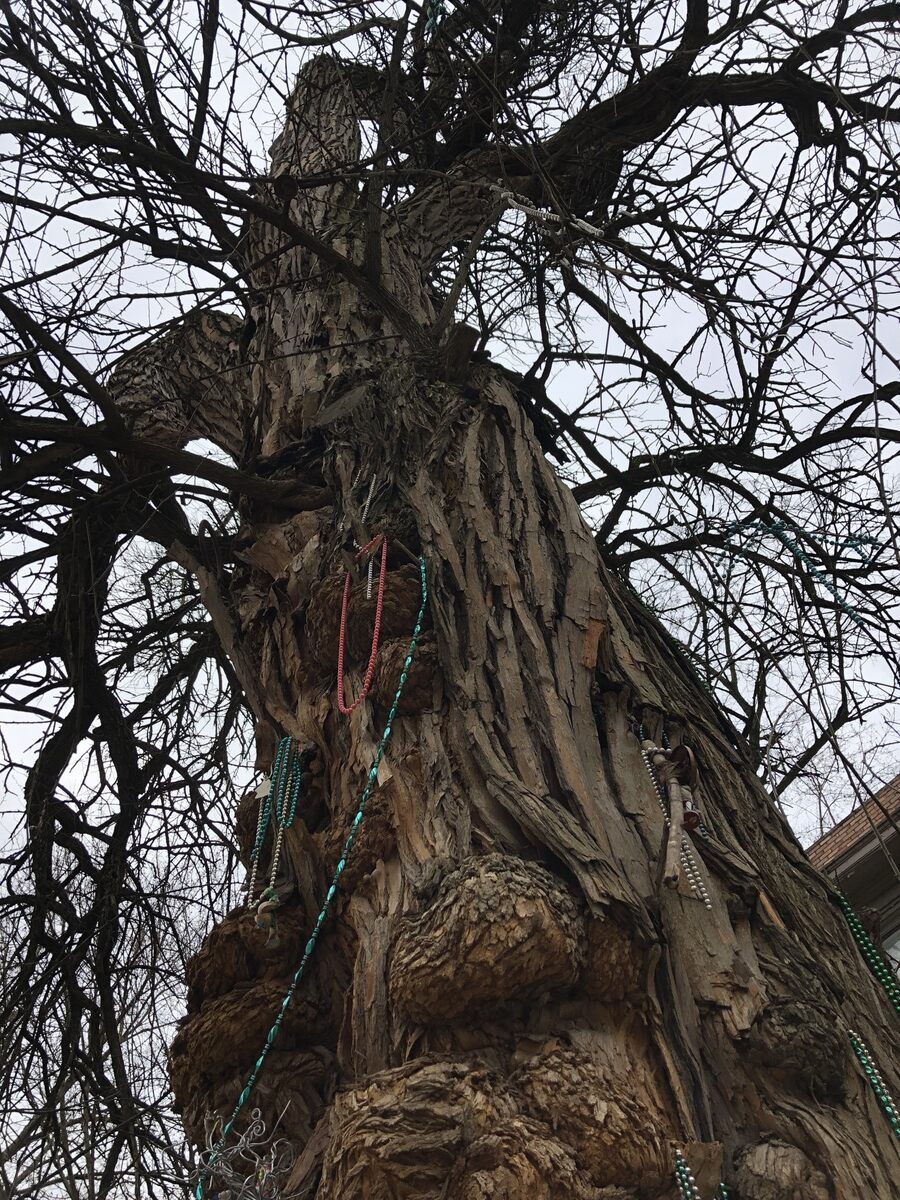
Locals place their offerings on this nightmarish gnarled tree so the witches won't summon another storm.

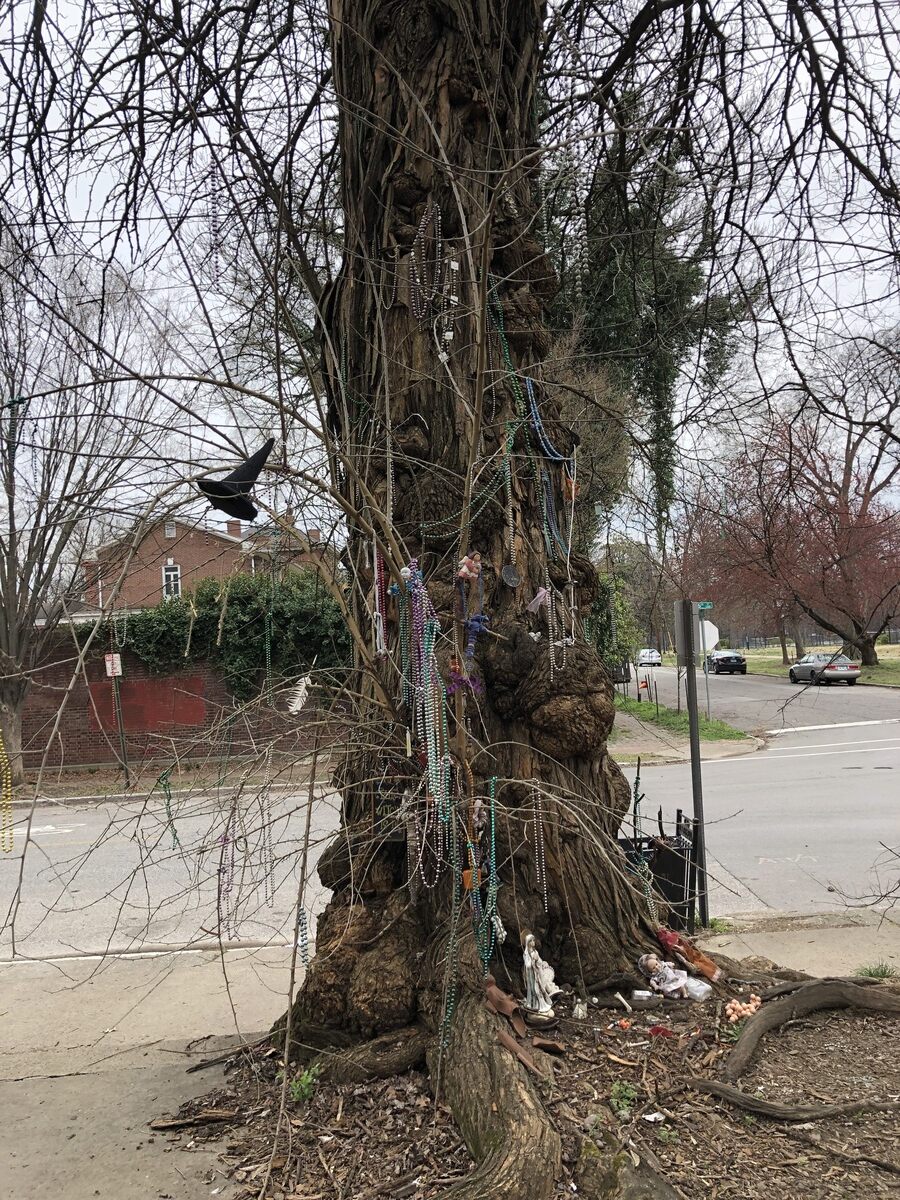
If you’ve walked past the corner of Sixth Street and Park Ave in Louisville, you’ve probably seen what can only be described as a natural monstrosity—a tree so knotted, tortured, and misshapen that it could easily serve as a portal to the underworld in a Tim Burton film.


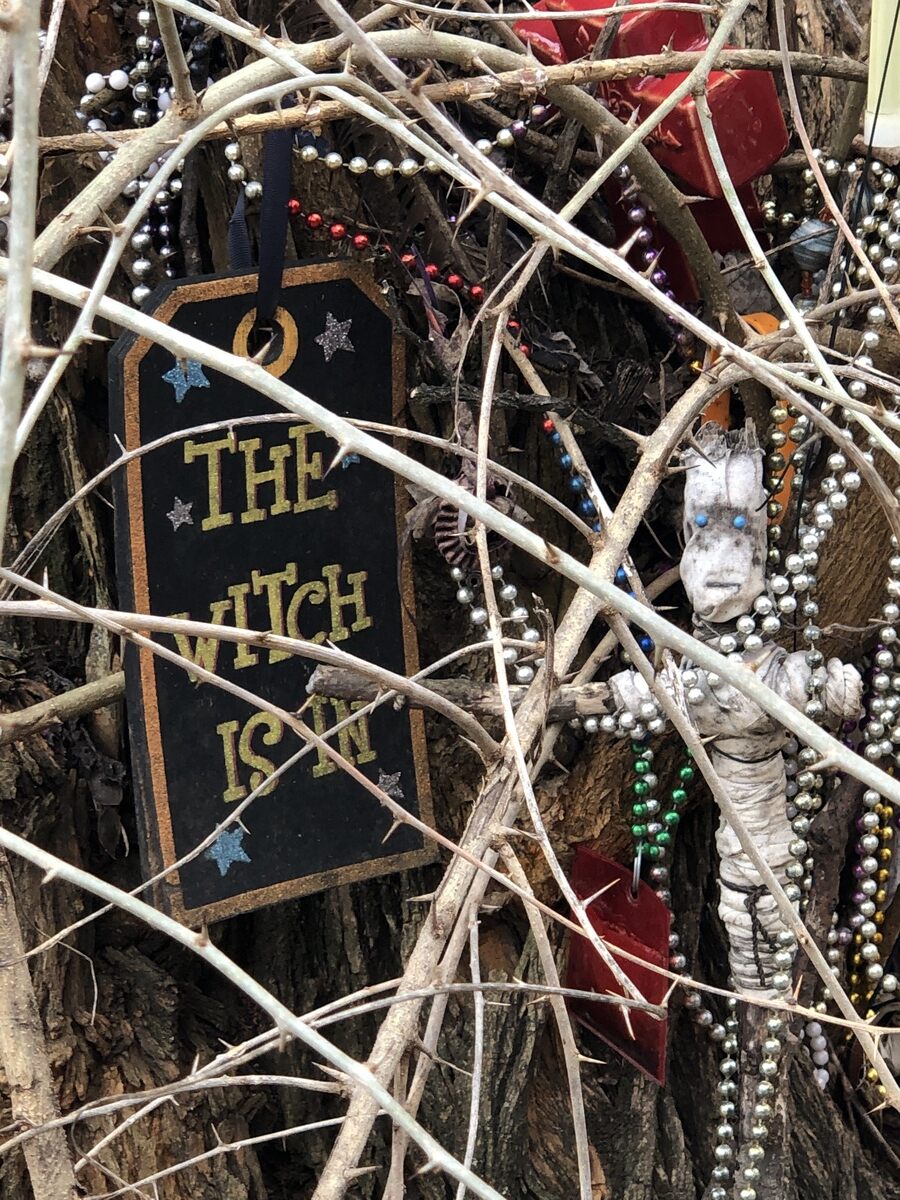
Even if the tree didn’t resemble something from a nightmare landscape, all of the trinkets, baubles, and bead necklaces hanging from the branches would make it impossible to miss. They were placed there by locals to appease the vengeful witches.

According to local lore, in the late 19th century, this tree was the gathering place for a coven of witches. There they performed their ceremonies and generally didn’t create too much of a nuisance. Until, that is, a city planning committee decided to remove the tree ahead of the annual May Day celebration. 


This displeased the witches greatly. So much so, they cast a curse. And exactly 11 months to the day after the tree was cut down, the city suffered a storm so severe that it was generally assumed that the witches had made good on their curse and summoned a storm demon. During the storm, lightning struck the stump of the old witches tree and a new tree began growing there. Not a healthy, happy tree, but rather the otherworldly thing that stands there now.

Whether there’s any truth to the tale or not, it appears that the community has decided to err on the side of caution and leave small tributes on and around the tree to keep on the witches’ good side.


Friday, April 19, 2019

Anticipatory Nostalgia

This is a much older piece, a decade at least, but I think it's relevant to our current, shared trajectory. It's something I've felt often and in different ways in my travels and explorations over the past few years, and it's something I know I'll feel again. A sense, perhaps, that I'm on the right track.

Anticipatory Nostalgia

“What do you mean?” she asked without taking her brown eyes off the sky.

“Anticipatory nostalgia,” I repeated, doing my best as a teenager to sound wise. It was something I’d thought of earlier that day in the car with her and her friends. “There’s probably some multi-syllabic German word for it…” I’d been reading Milan Kundera at the time and he always seemed to be able to find just such a word. Even though of course he was Czech rather than German.

“But it just means I’m looking forward to remembering the moment we’re in right now.”

I could see her breath rise and disperse like miniature clouds. It was cold, maybe November, and we were lying in her back yard looking up at the sky, waiting for the first shooting stars that were supposed to occur around 11:40 pm, Central Time. I remember there being somehow both snow on the ground and the smell of fresh-mowed suburban grass. I was bundled up, wearing a burgundy scarf that she and her family had given me as a Chanukah gift the week before. The fabric scratched and irritated my neck, but I didn’t really care. There weren’t that many truly perfect moments up to that time in my life. Thankfully I’ve had more since then and more yet to come, I hope.

I could smell the frozen Michigan air, stinging my nostrils as we lay on the ground, looking upwards. The radio was playing from just inside the kitchen off the porch. It was “Don’t Dream it’s Over,” by Crowded House.

“It’s like listening to this song,” I said. “I know I haven’t really lost anything yet, but also know that I will. I somehow identify with the lyrics, with the music, it’s emotional but it’s about an emotion I’m not really familiar with yet. But I know I will be, one day. So I’m sort of nostalgic for the way that the song will make me feel sometime way out in the future when we listen to it. Does that make sense?”

She thought about it for a moment and then said no. And then she covered my mouth with her balmed lips and enveloped me in Altoid mint-scented warmth as the meteorites started to burn up in the atmosphere above us.


Looking back I got it part right, which I suppose means that I also got it part wrong. I do reflect on it years later, and I do feel a shadowy nostalgia when I hear that song. But it doesn’t mean what it did then or since then. It’s been infused and layered over so many times with other experiences. There were times when I thought back on it alone and it stung tears from my eyes. There were other times when I thought back on it from a place of contentment and it made me smile. And it’s not the one that I remember being with, with whom I remember it now. But those are just details for the editorial department of the heart.

Now it’s changed once again. The nostalgia that I once anticipated has occurred and has itself become a memory. It grows cooler as I grow more distant from it. It's faded now to being the emotional equivalent of having forgotten something you misplaced and only remembering that it was something of great personal value. You know, that gnawing sense that there’s something you should be remembering.

There’s probably some multi-syllabic German word for that too.

Monday, January 7, 2019

Travels with Tinker Bell

Is it really any surprise that a man dedicated to indefinitely prolonging his own childhood should end up living down the road from the Magic Kingdom with a diminutive, non-human companion named Tinker Bell?

I'll admit it, I haven't always had the easiest time making commitments.This is evidenced by the fact that it wasn't until my mid 30's that I got married, and it is only now in my 40's that I've become the newest convert to the religion of dog ownership.

Tinker Bell having a complimentary "puppy sundae" from Leopold's in Savannah, GA

I was reluctant. I hemmed and hawed and kept putting it off, but Jen was insistent. Having grown up with a Shih Tzu named Wonton, she made a compelling and heart-felt case for the necessity of having one here in Florida. For my part, I balked at the cost, at the commitment, at having to wake up at three in the morning to take her out in the middle of a storm, at all of the reasons you can think of not to have a dog. And then, after playing for just five minutes with a spunky, curious little ball of fur that wasn't quite two months old, I melted.

Maybe it's a bit of karmic retribution for having given my mother such a hard time about spending more time and affection on canines than on humans. Her own dogs, Portuguese Water Dogs and Chesapeake Bay Retrievers, have collectively earned more titles and initials following their names than I will ever possess in ten lifetimes. But having now spent nearly two years with Tink, it is no hyperbole to say that her company has flipped my perspective on the matter and also transformed my daily life here in Florida for the better. In short, I get it.

Tinker Bell in front of Castillo de San Marco in St. Augustine, FL

Since leaving corporate america to work for myself, from a home office, nearly ten years ago, it can get a little bit lonely at times. Isolation is a real challenge. But Tink gets me outside, interacting with the world outside my cave/tower. And more recently Jen and I have been taking her on our trips - Initially just within Florida but over the past year also to Savannah and Atlanta, and in the future probably all the way up north to Philadelphia. Our general rule is that anywhere we drive, we take her with.

Traveling with a canine companion (or "your royal fluffiness" as we sometimes refer to her) requires a bit of extra planning in terms of where we stay and what activities we bring her with for. Some hotels charge a pet fee, not typically more than $25, and we scout out doggie day care facilities so that we can give her time to play with friends while we explore museums and other places that aren't dog friendly. And we bring a folder with her medical records as proof that she's up to date on all of her shots. With this little bit proactive planning, the southeast has been surprisingly pet-friendly.

Tinker Bell paying her respects at the grave of Sideways the Dog in Atlanta.

We've even started looking for thematically relevant stops along the way - monuments to famous dogs and such. Tink's a remarkably well-behaved traveler as well. She loves the car - sleeping contentedly on Jen's lap for hours at a time. She's surprisingly adaptable regarding her food, not always the case with Shih Tzus from what I've heard. Jen's previous dog, Wonton, for example, turned her snout up at anything other than boiled chicken served to her on a napkin placed on Jen's parents' bed.

Can it be taken too far? I've read some travel articles that suggest some travelers would prefer that others leave their pets behind, and I understand and respect that point of view (hence the research into pet-friendly hotels and activities). Thankfully Tink isn't "typically" prone to late-night barking fits or other behaviors that would create a disturbance (all the same, we always have plenty of treats and a couple toys on hand for her). If/when bringing a pet impinges on the enjoyment and experience of others, than yes, boarding might be a better option. Should my travels with Tinker Bell ever prohibit Jen and I from exploring any of the items on our adventure lists or deter us from interaction with other humans, then it might be time to rethink things. Lastly, I've informed friends and family that should they see me pushing Tink in a stroller, I invite them to set up folding chairs in a semi-circle in my living room for a "friendly chat."

Tinker Bell visiting Brownie the Town Dog's resting place.

As I write this, Tink is curled up by my feet, waiting for me to finish my post so that I can get on to the day's more pressing matters which include belly rubs, playing with squeak toys and a long walk. Maybe chasing some squirrels and lizards up trees.

On a final note, I should mention that in addition to being my friend and companion, Tinker Bell is also my editor - any misspellings or errors in this post or others are hers entirely.

Tinker Bell and I at DeSoto National Memorial. 

Friday, January 4, 2019

Exploring New York: Shadows of the Original Trial of the Century

The man whose architecture ushered in the American Renaissance would ultimately come to symbolize decadence.

When I mention "the Trial of the Century" people generally assume I'm talking about the OJ Simpson trial, and the name Stanford White doesn't usually mean very much to them. It should though (and if it doesn't anything to you either, I encourage you to read "The Girl on the Velvet Swing"). You see, long before a back Ford Bronco made its famous dash for the border and into our shared consciousness, there was another "Trial of the Century." On the surface these two trials have a lot in common, both featuring the fall of prominent public figures, jealousy, murder and subsequent media frenzies. But scratching the surface reveals very different stories.

Stanford White seems to have had two passions. The first, for architecture, is the one that brought him wealth and fame. The second, for sexual deviance with an emphasis on corrupting young women, is the one that got him murdered - shot three times at point blank range during a play at the old Madison Square Gardens by Harry Thaw, who claimed that White had ruined his wife, model and actress Evelyn Nesbit. Spectators at first applauded, thinking it was one of White's pranks, but after a few moments, once they realized what they had just witnessed, panic erupted.

I'll leave off there, as the purpose of my post isn't to rehash the sordid story, which you are more than welcome to explore elsewhere. Rather, I wanted to see what remnants of White's rise and fall I could find in and around Midtown Manhattan.


I started off by walking to 160 Fifth Avenue, the old offices of McKim, Mead and White. J.P. Morgan, the Astors and the Vanderbilts were just a few of the many prominent clients served by the firm. Other projects included the triumphal arch at Washington Square, the Cable Building, the Bowery Savings Bank, the Judson Memorial Church, the Gould Memorial Library and the same Second Madison Square Garden where White met his end. One can imagine in the days following White's murder, his partners rummaging through his desk full of drafts and documents, seeking out any incriminating evidence that could damage the reputation of the firm and their own careers. Today though, you won't find any traces of the once great firm at what used to be their offices - just a Club Monaco on the first floor.

From there I took a short walk to 22 West 24th Street, which was the site of White's sex crimes. What Nesbit once described as a lavish love nest with heavy re velvet curtains as well as the infamous swing with red velvet ropes and ivy-styled green similax, is today just a gap between buildings.


Not finding any remnants of the seedier side of the story, I turned my attention instead to the higher qualities of White's legacy, with a visit to Washington Square Arch in Greenwich Village. Modeled after the Arc de Triomphe to commemorate the centennial of George Washington's presidential inauguration, it is the structure for which White should be most remembered for, according to his great-grandson.

There's one other physical trace of White's story, which I plan to see in an upcoming visit, not to New York but to the Philadelphia Museum of Art, to see the Golden Gal of Old Madison Square Garden. Once marking the highest point in the city, the nude statue of Diana with her bow drawn, is all that remains of the Beaux Arts masterpiece that White brought to life - and the very same building in which his own life ended violently.

Tuesday, January 1, 2019

Chihuly Collection

(This piece was edited and published on Atlas Obscura. You can see it here.)

The first custom-designed building to showcase the works of Dale Chihuly is a wonderland of glass and light.

A world-renowned pioneer in the studio glass movement, for more than 40 years Dale Chihuly has created innovative, organic and large-scale glass artworks and installations. In 2017, the collection moved to a new space and the first building custom designed around the artist’s work.


Visitors enter the main body of the 11,000 square foot collection through a hallway of the artist’s works, which is not unlike wandering through a kaleidoscope.

On display are several massive chandeliers that look somewhat like a colony of crystalline giant tube worms decided to celebrate Mardi Gras together. Other works featured include the icy, electric blue Tumbleweeds suspended in its own room, the Macchia Forest of organic bowls and the bright, celebratory Mille Fiori as well as various Ikebana and Niijima Floats.


Also on display are many of the artists’ works on paper, as well as pieces from both his Sea Form and Venetian series. Interestingly, one of those Venetians on display was once stolen from the collection, only to be returned the following day in a crude, taped-up box. The work was unharmed, but it had also been wiped clean of any fingerprints and at the time of this writing, the case remains unsolved.

Know Before You Go
A thirty-seat theater runs a loop of interviews and information about the artist and some of his more well-known installations around the world, and the gift shop has original works available for sale. Tickets for the collection are also good for a free glass blowing demonstration across the street at the Morean Glass Studio & Hotshop.