Tuesday, June 26, 2018

Three Years, Eleven Days

That's how long you've been gone now, old friend. In that time Jen and I have moved to a new city, I've become a dog owner and the country has elected not just a new president but an entirely new type of president (America's first modern strongman is about the most diplomatic way I can think to put it). I imagine what you would say about all of this. I keep you with me as I write this, as I try to recount and recapture so many of the times that mattered most in making us. Your epilogue has become the prologue for readers here, and in such a manner your story continues. Maybe not directly, but as a root cause and driving force, as catalyst, in my current exploration. And so I've decided to share the hardest thing I've written thus far - in doing so, making our shared history opensource. I like to think you would appreciate that.

Remembering Steve

In the movie “Almost Famous,” the actor Phillip Seymour Hoffman, who also left the world too soon, in character as Lester Bangs tells us, “the only true currency in this bankrupt world is what you share with someone else when you're uncool.” If that’s true, than Steven and I were like the Bill Gates and Warren Buffet of our childhood world. We were epically uncool. And this is before being uncool became cool, before it was ok to have a 20-sided die in your pocket at all times, or collect comics, or sit up in your room late into the night playing computer games like Zork and Loderunner or committing cheesy horror and sci-fi movies to memory, or writing and publishing zines. Back when we did these things they were not cool. They were more like a recipe for being insulted, getting a wedgie and sometimes having your lunch money pounded out of you. But even as introverts and outsiders, the one spot of redemption was that we had each other to share and endure the ordeal with.

We went to Bluebell day camp together where we both dreaded any sort of athleticism. When it came to baseball, I was the chubby kid, slow, an easy out at first. And Steve, he was the strikeout king – possessed, quite possibly, of the worst eye-hand coordination of any adolescent I’ve ever known. But one day, when all the outfielders had come in close, I remember hearing the crack of his bat, finally connecting with the ball as he drilled it way out over center field. Home run material, a triple at least. Once it sunk in, Steve dropped his bat, looked at all the stunned faces on both teams… and promptly ran the wrong way, from home plate to third base. And that right there is as perfect a snapshot of our childhood together as I can think of.

Without Steve, almost half of my own childhood vanishes. We came of age together, had dual residency in each other’s households, we would talk on the phone or push through the thin strip of woods that separated our developments to stay at each other’s houses, sharing our hopes and writings, our fears and visions of the future, of what we would become. And now we have, I became a small business owner, married, living in Chicago, and Steve found his confidence and the realization of his passions in family, as a devoted father and husband. Every time we spoke, he would talk to me about Benjamin or Rafi’s latest artworks or antics, about Benay’s love and support. He grew from an awkward and shy kid into a profoundly thoughtful and sensitive family man in a world that frankly seems to place too little value on such things. Whenever I was down, defeated, whenever I fell short of my often delusional grand plans and designs, he was the guy that reminded me, sometimes being a truly good person is a far more meaningful and important aspiration than being a great one.

We went from being childhood best friends to being that person for each other that you call in the middle of the night when you need to talk to someone who doesn’t just know you, but who knows every iteration of you that you’ve ever been. The inside jokes, the day camp memories, first relationships and breakups, bar mitzvahs and weddings, high school and college graduations, the words of encouragement to keep writing, keep being creative, and the visits we made across cities to see each other over the years. All of these moments somehow both remain and depart with him. One side of our late night conversations fallen silent.

It seems right to close with another quote from a movie. It’s from “Stand by Me,” which I remember watching with Steve for the first time from the beige couch in his parent’s family room. “I never had any friends later on like the ones I had when I was twelve. Jesus, does anyone?”


Sunday, June 24, 2018

Exploring Florida: Castles in the Swamp


"A man’s home may be his castle” is a phrase that some interpret far more literally than others.

It wouldn’t be entirely accurate to say that America has no architectural tradition of castles. It may not have the same sort of imposing stone behemoths perched atop hills and mountains that you find throughout Europe, but it has instead a peculiar variation – what I’ll call DIY castles. These oddities dot the American landscape in often the most unexpected places, including here in Florida. They range in style and materials, constructed from concrete to coral to metal printing plates to just about any material at hand, but they are all related if by nothing more than the visions that drive their creators.


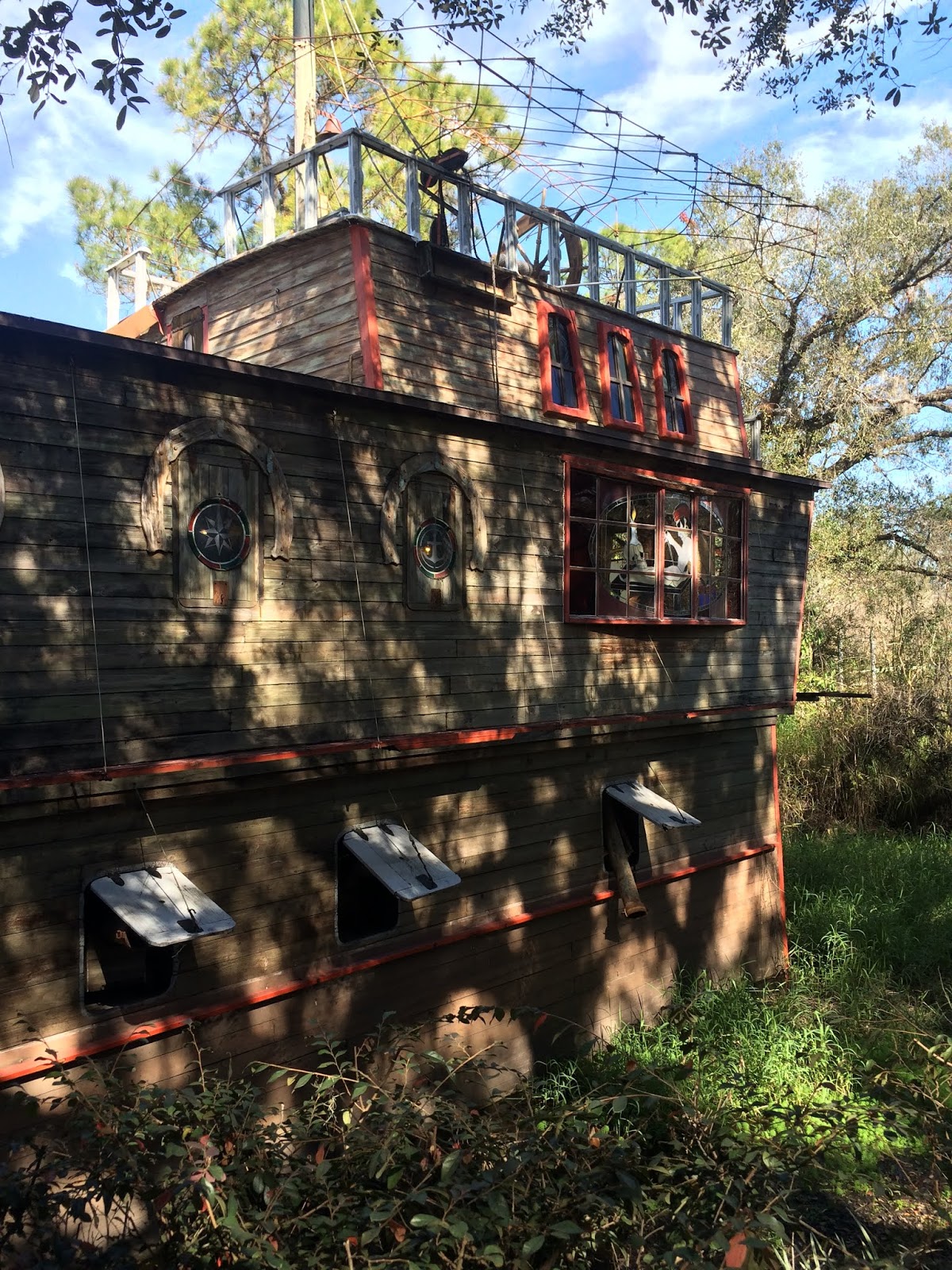
Solomon’s Castle
Sprouting up from the wilderness (which in central Florida translates to swampland) in Ona is a marvel and almost certainly the best know piece of functional artwork created by sculptor and stained glass artist Howard Solomon.


The “da Vinci of Debris” as he’s been called, began what evolved into a gleaming, three-story castle in 1974 when a local newspaper went under and threw out their old printing plates. It has since expanded to include a moat, a boat in the moat, and a lighthouse which was the last element of the castle to be completed before Solomon’s death in 2016.


The boat in the moat serves as a restaurant, which has surprisingly good food. When Jen and I went to visit, a local musician was performing in the seating/eating area, which added just the right touch to what was a happily quirky experience. The tour featured not only Solomon’s vast collection of artwork (ranging from wire sculptures to found object art to stained glass work), but also his wit and playfulness, as the staff continues to use his script. As a punster myself, I found this tremendously amusing (even as Jen groaned and rolled her eyes beside me).


What struck me most, beyond the scale of the endeavor, is that here stands a monument not only to chasing but to capturing and harnessing one’s childhood fantasy – playfully reshaping the world through a fusion of creativity and obsession into something whimsically otherworldly. See it if you have the chance.

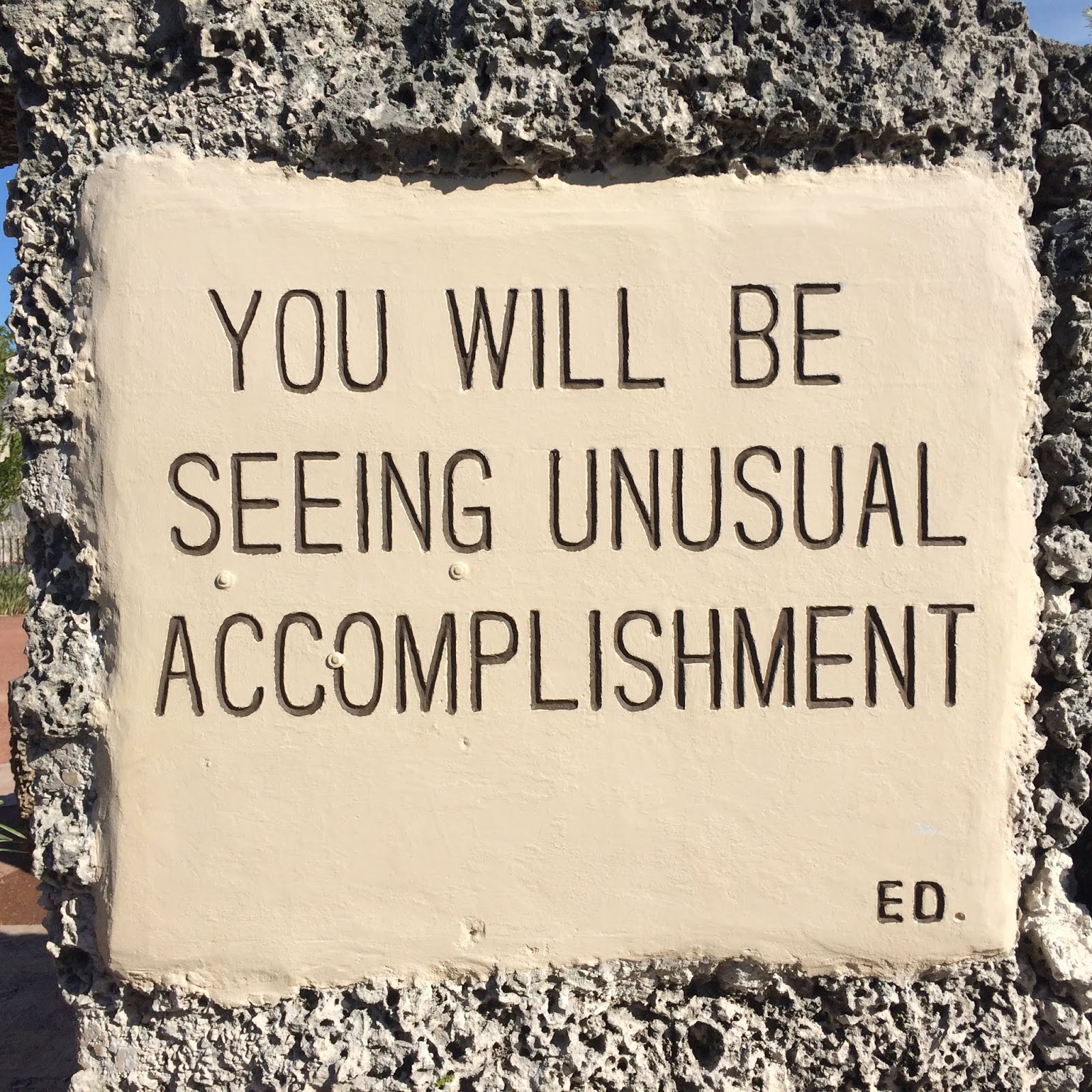
Ed Leedskalnin’s Coral Castle
If Solomon’s Castle is forged out of scrap metal and childhood dreams, than Ed Leedskalnin’s creation is a contrast in terms of both material and motive. Constructed entirely from oolite limestone, Coral Castle is an epic monument to one man’s unrequited love.


The diminutive Latvian Leedskalnin was rejected by his love the day before they were to be wed. His bride, one Agnes Skuvst, was sixteen at the time (he refers to her as his “Sweet Sixteen” – which is also the title of the Billy Idol song and video later recorded at Coral Castle). After this, having apparently contracted tuberculosis, Leedskalnin moved to America and sought out the healing heat of Florida.

He built his first castle, “Ed’s Place,” in Florida City but relocated it in 1936 to the unincorporated territory of Miami-Dade County over property concerns. There he continued his work, which lasted 28 years.


The castle came to contain a number of unique structures, including the “Rock Gate” at the entrance, an accurate sundial, a Polaris telescope, multiple rocking chairs in the shape of crescent moons (a motif carried throughout the castle), a heart-shaped table, a throne and two 25 foot tall monoliths.

As outgoing as Solomon was, Leedskalnin was equally reclusive, bordering on paranoid, which only further fueled speculation as to how he was creating his castle. Some claimed that he used magic to levitate the blocks of coral. Others, based on the astronomical theme, assumed that he was using alien technology. None of this was true – all he utilized was basic construction equipment (levers and pulleys and such) with a degree of precision that would make any modern engineer proud.


Leedskalnin passed away in 1951 of a kidney infection, without his lost love ever having come to visit the world he carved for her and their imaginary children.

The tour at Coral Castle is also well worth the entrance fee (a bit more today than the 10 cents it cost when Ed lived there). There's fewer chuckles to this tour and to the castle as a whole, but it is not without a certain dry humor and, to be sure, no less amazement.


While Solomon caught his dream, Leedkalnin it seems, pursued his to the very end. Both, however, embody the sort of obsessive (arguably delusional) passion that drives a very few to erect castles in the swamp.

And they’re not alone – within Florida there’s also Castle Otttis (yes, that’s with three T’s) in St. Augustine. Beyond the state of Florida there’s Cano’s Castle in Colorado, The Junk Castle in Pullman Washington, The Houston Texas Beer Can House and a great many others. I’d venture that even as you read this, somewhere, someone, for reasons unknown to us, is this very moment sifting carefully through and sorting debris to load into a truck and bring back to the site where they will eventually break ground.

Thursday, June 21, 2018

The Hand of Fate


(This piece was submitted to Atlas Obscura and is currently pending publication)

Nestled inconspicuously among tiki bars, surf shops, cigar stores and other boardwalk tourist traps along the waterfront at John’s Pass stands an ominous warning and striking sculptural memorial to Florida’s fisherman lost at sea.


Many of us, myself included, seldom pause to think about where and how the sushi on our plate arrived there… but those who fish Florida’s Gulf Coast, for sustenance as well as for sport, confront the vicissitudes of the ocean on a daily basis.

Unveiled on October 29th, 2011, the nine foot tall sculpture was the result of a joint effort between the John’s Pass Village and Boardwalk Merchant’s Association, the Outdoor Arts Foundation and artist Robert Bruce Epstein. Epstein’s sculpture depicts an oxidized, Poseidon-like hand from which a massive wave rises, looming over a hapless fishing boat. From this we can assume that the fate of the crew hangs in the balance.


Inscribed around the base are the names of just some of those commercial and recreational fishermen who never made it back home. While the exact number is unknown, the St. Petersburg Times estimated that more than 140 individuals have been lost off the Gulf of Mexico in Florida since 1933.

A poem inscribed on the front on the monument reads as follows:

“I pray that I may live to fish…
until my dying day.
And when it comes to my last cast,
I then most humbly pray:
When in the Lord’s great landing net
and peacefully asleep
That in His mercy I be judged
big enough to keep.”

Tuesday, June 19, 2018

The Metaphysics of Storytelling


I love to get lost in a good story – I’ve been doing so since at least the fourth grade, when one of my teachers handed me a copy of The Phantom Tollbooth. Having become a professional writer, I like to think I can weave a fairly decent story myself, but then, you’ll be the judge of that I suppose.

There’s something seemingly metaphysical that occurs in reading a story – I think it happens at the precise point where you stop seeing little patterns of words on the page or the screen and suddenly see instead what the words mean (this is the Delta Phenomenon as described by Owen Barfield – that moment when the words become the thing they describe – which gets into symbolic reasoning). You’re drawn in, the space around you dematerializes and you are immersed the images that the story conjures. All stories, in this sense, are incantations.

Storytelling is, by nature, translocation between the physical realm and the one described/imagined. A story, a tale, can take on other properties and purposes: illusion, invocation, conjuration, exorcism. Sometimes, just briefly, it can be necromancy – gently sliding a pin through the veil, so as to whisper between worlds with absent friends and family.

When it comes to storytelling as magic, I can think of few equal to Clive Barker. He’s a master storyteller, across multiple mediums ranging from literature and film to visual art and video games. His work is often and best known for being otherworldly, in ways both inspiring and terrifying. He knows how to pluck the right word, the right phrase to summon the right image, all the while moving us toward the destination he’s planned.

I’ll leave you with a passage from his novel Sacrament that has stayed with me over the years; about storytelling as act of both creation and completion:

“I am a man, and men are animals who tell stories. This is a gift from God, who spoke our species into being, but left the end of our story untold. That mystery is troubling to us. How could it be otherwise? Without the final part, we think, how are we to make sense of all that went before: which is to say, our lives?

So we make stories of our own, in fevered and envious imitation of our Maker, hoping that we'll tell, by chance, what God left untold. And finishing our tale, come to understand why we were born.”

Sunday, June 17, 2018

The Secret Room at M.S. Rau Antiques

(This piece was edited and published on Atlas Obscura. You can see it here.)

Many a serious collector of fine art and antiquities will be familiar with M.S. Rau Antiques in New Orleans’ French Quarter. What many of them might not realize is that the greatest treasures in this renowned collection lie behind a secret door toward the back of the building, which has been painted to look like a bookcase.


On the other side of the trick door, the secret room contains an astounding variety of museum-caliber rare artifacts and art.

There paintings by greats such as Monet, Renoir, Norman Rockwell, Winston Churchill and others; Napoleon’s death mask; an Enigma machine; an etching by Rembrandt; furnishings that have been inspired by or adorned palaces around the world; sculptural works and more.


Works you might expect to see in museums can be found here for purchase, but you’ll still need a generous-sized budget if you plan to take them home with you.

Backstory


This blog has a trajectory, an agenda if you like, in that I know where it wants to go. I know where I want to go with it – a handful of specific memories and experiences I’d like to share, in pieces, about a particular friend I had and a few of our shared experience. Kindred spirits, he and I, and I’d like you to get to know him through the impact he’s had (and having now) on me – I suppose that’s really the only way you could know him now if you didn’t before. It will take some time, but we’ll get there, I think. We will come to the place that this blog wants to go. Tell you what, if you keep reading I’ll keep writing and we’ll see what takes shape. Deal?

But before we can get to where we’re going, I need to share where I’ve been and how I arrived at this point. If all that comes next is to make sense, I need to provide insight into the two things that happened my last year living in Chicago that altered my own trajectory. Every once in a while, flaming cosmic debris (better know as meteorites) come blazing through the atmosphere impacting the earth with enough force, in some cases, to forever alter the environment. My last year in Chicago, I experienced two events which, like the aforementioned meteorites, rocked and tilted my personal world.

The first was painful – one of my closest friends, Steven, died suddenly. I had spoke to him the night before, which likely makes me the last person outside of his home that he talked to. I remember that it was late in Chicago, probably around midnight, which made it even later for him (eastern versus central time zones). For just a second I thought about just letting it go to voicemail and following up the next day, but I answered instead (a kindness that the universe extended to me, if you believe in such things). And we talked about nothing in particular and nothing of any earth-shattering significance whatsoever. He told me about summer plans with his two sons and his wife. We agreed to pin down a date in August or September to see each other – it had been a few years (the last time I saw him he was one of the best men in my wedding). And that was it – nothing profound, nothing unusual. Certainly nothing that would suggest that in about 18 hours my wife would be telling me as I got out of the shower, wrapped in a towel, that Steven was dead. My mother had called and spoke with her to pass on the news. I tried to think of who I knew named Steven. Oh God, did she mean my cousin? Seeing the confusion on my face, Jen put her hand gently on my wet shoulder and said very slowly, Steven Josselson.

Steve and I - we're probably about 16 years old here.

Game three of the Stanley Cup playoffs was happening in the background. It all suddenly went weird on me and became just a lot of loud, incomprehensibly garbled images and noise to me. Maybe that’s what having a stroke is like.

It still took me a couple minutes, I tried to explain to her that it was a mistake, I just spoke to Steve the night before and he was fine. Either she or my mom or someone in the chain of communication had gotten it very, very wrong.

But he wasn’t fine. It wasn’t a mistake.

Apparently he’d had a bad drug reaction. The combination of pain meds and a new antidepressant. Or a new pain meds and the old antidepressant. I don’t remember which. I’m actually not sure I ever learned which. I didn’t, couldn’t ask. Even now I haven't really heard the full story. Maybe I don’t want to know it, because knowing how his story end make it irrefutable, final and complete. The ultimate cosmic spoiler, as the end becomes un-unknowable. But I wasn’t thinking about all that at the time. All I knew was the feeling of my personal history collapsing without one of its central pillars for support. The one person who knew me best and across all the different phases and chapters from preteen to middle age, was gone.

It shocked me. It pissed me off. It sent me into a brief spiral of despair. Yes, I went through all the phases in more or less the correct order before I could accept it. And then something unexpected happened. It galvanized me. It became a constant reminder that any of us can be gone tomorrow. Or tonight. Or right this very moment, before we even finish writing and reading this sentence. All those things I so desperately wanted to do, places to see, artworks to create, books to write, trips to take, projects upon projects upon projects, time now to stop putting them off. Every tick of the clock became a countdown, and I found a hunger that was hungry to become something even bigger – to fill the absence where my friend had been. But what to fill it with?

Which brings me to the second event.

Jen and I decided to leave Chicago and move to Florida. Steve’s death had put me in the right mind for a life change. Jen and I had talked about it before, about not waiting until we’re too old to enjoy living by a beach. Our neighborhood, all of Chicago it seemed, was becoming more violent. Twice in a matter of weeks the convenience store at the corner had been robbed at gunpoint and both times I’d been arrived just minutes after it happened. The cost of living seemed to keep going up every month and what we got for the money we spent seemed to keep shrinking. And so we scouted out Tampa and we decided to do it.

I did, however, have one condition.

I didn’t want to have another tearful farewell, like saying goodbye to Steve. This time, I would control the how and why and when. And as I thought about my ten years in the city, I realized that I didn’t know it all that well. I knew parts of it like the back of my hand, but far more of it was a mystery to me. Terra Incognita. I decided to spend my final months there seeing and experiencing as much of it as I could – filling up new rooms in my mind. Celebrating the city by deepening my knowledge and experience of it.

Jen and I set about making our first bucket list – researching all of the experiences unique to the city, from eating Chicken Vesuvio to seeing a Cubs game at Wrigley Field, having a shot of Malört and visiting the old home of Nelson Algren. In doing so, I stumbled across resources like Roadside America, Weird USA, and Atlas Obscura. And collectively, these opened my eyes to a new way of seeing the place I lived. I was suddenly reborn to Chicago, to all cities, to everywhere. I read up on and visited streets that had been built up around and over, literally swallowed by the city; about strange and unusual monuments and collections; and in this manner the city and I were made new to each other. The sense of there being the possibility of something wondrous hiding around the corner of every alley returned to me.

Reading Nelson Algren on the steps
up to the place he once lived.

The city was alive with magic again. It really hadn’t changed in any tangible way, but I’d found a fresh set of eyes with which to see and feel it again as if for the first time.

Jen and I are still working on that Chicago Bucket List – every time we visit for a few days we knock off another couple items. And we’ve created more lists for other places we’ve visited. Tampa, New York, Key West, New Orleans, Philadelphia. Places I’ve never been to before now offer up their unique oddities, begging, it seems, to have them seen. And those places I thought I knew by heart continue to surprise me and yield unexpected treasures.

Losing my friend Steve led me, circuitously, to discover the city I lived in, and ultimately to resume chasing down the sort of childhood wonder and adventures that he and I shared growing up. Tragic and beautiful and fleeting and strange. That’s the journey I’m on now - the one you’re sharing with me.

And I’m glad you’re here, by the way. You could be watching the game. Or playing a game. Or shopping. Or out on your boat/sled/plane/camel. Whatever and wherever you are, you’ve chose to be here, reading this. Reading my backstory.

So thank you. I’m finding that conveying these experience gives them a new dimension. I think of it as the difference between being a tour guide and being a tourist. I hope you’ll stick around – I’ve got a lot more I want to share. I am - we are - in fact, just getting started.  

Friday, June 15, 2018

Exploring Chicago: The City in Miniature


(This piece was originally written as part of an ongoing series for Tower Topics, a newsletter produced by and for the residents of Imperial Towers in Chicago. The publication was discontinued before this piece was published.)

At street-level, it’s easy to feel tiny in a sprawling metropolis– lost amidst the mass of people and dwarfed by the towers that reach ever higher into the sky. Perhaps that’s why so many of us choose to live aloft, where, removed from the bustle and hustle and noise, the city seems serene; everything made more manageable in miniature.

Whether it’s a need to shift the scale of our relationship with our surroundings, a desire to contain and control our world, a means of simply passing the time or something else entirely, the profusion of tiny collections, doll houses, dioramas and model train sets must be saying something about our culture, about our nature as humans.  Koyaanisqatsi, perhaps. Whatever the reason behind this particular obsession, Chicago offers ample opportunity to explore and interact with various man-made microcosms.

Garfield-Clarendon Model Railroad Club
Just a few short blocks north of Imperial Towers is a wonder worth visiting. During Open House Chicago 2016, when hundreds of unusual and normally exclusive buildings were open to the public I was able to stop in at the basement of the Clarendon Park Community Center, which has been home to the club since 1963. The club itself was formed originally in 1947.


Known as Garfield Central, the current layout includes nearly 1,400 feet of hand laid tracks, fully signaled dual main lines, painstakingly crafted details (including water towers trees and three large bridges) and both urban and rural scenery. Operating at scale speed, a full trip around the tracks takes nearly half an hour and makes this one of the largest model railroad endeavors anywhere on earth.

Thankfully you don’t have to wait for the Architectural Society’s annual Open House or other special events to see the railroad. It is open to the public year-round on Friday nights from 7 to 9:30 PM.


Chicago History Museum Dioramas
Closer to the loop, you can find a very different set of miniatures within the Chicago History Museum. Captured in intricate detail are seven scenes showing key people, places and events that defined Chicago’s transformation from a small trading outpost to one of the largest cities in America. Specific dioramas include a view inside the Sauganash Tavern circa 1833, the White City of the 1893 World’s Columbian Exposition, the Washington Park Race Track as it appeared in 1884, and arguably most striking of them all, the Chicago Fire of 1871.


No artifacts at the museum have been on display longer. Maintaining the dioramas entails ongoing restoration and renovation and repair. The first such effort was undertaken in 1951 and the most recent initiative began in 2004.

Even if you can’t make it to the museum, you can find a great video of the dioramas here: https://www.youtube.com/watch?v=Vmso0JZjga8

Thorne Miniature Rooms
Not to be outdone by the Chicago History Museum, the Museum of the Art Institute of Chicago has on display an impressive miniature world of its own. 

As a child, Narcissa Nidblack Thorne loved dolls and dollhouses. As an adult with ample resources, having married the heir to a department store fortune and traveled throughout Europe, she began to amass a collection of miniature figures and accessories. To house this collection, in 1932 she commissioned the construction of several rooms. This project soon became a passion and she began overseeing the construction of even more elaborate rooms with architecture specific to various places and time periods in European and American history.


In the 1940’s her rooms began traveling to museums throughout the U.S. before finding a permanent home at the Art Institute. Today, you can get a glimpse of history through the windows of 68 separate rooms, each built to the scale of 13 inches.

More Tiny Worlds to Explore
Year round you can find The Great Train Story Diorama on display at the Museum of Science and Industry. There are also a number of extraordinary seasonal displays and events, such as the annual Lego Train Show at Cantigny Park, the Wonderland Express at Chicago Botanic Garden, and the Enchanted Railroad at Morton Arboretum.

So the next time the city seems overwhelming with its constant massive construction and building projects (often matched in size only by the ambitions and investments behind them), keep in mind that some of Chicago’s most breathtaking displays of architecture and engineering may also be its smallest.

About my "Exploring Chicago" series: Chicago will always be the first city I really fell in love with. The history, the people, the food and just the feeling I had living there – it reminded me of what it means to be at home somewhere. But Jen had lived there her whole life and always wanted to move to Florida, and I agreed. After all, it’s a big world with a lot to see and maybe it’s possible to become too comfortable in one spot. So we made a bucket list of unique things we wanted to do before we left the Windy City and as a means of saying farewell to a place we loved, we devoted ourselves to getting to know it better, finding its hidden streets, its local flavor and its secret history. That urban exploration has turned into a passion that we’ve continued in Florida… but Chicago still occupies a unique place in my personal story. This series of articles allows me to share that intense curiosity and sense of wonder while adding yet one more dimension to my experience – that of fond reflection.